Partial Solar Homelab
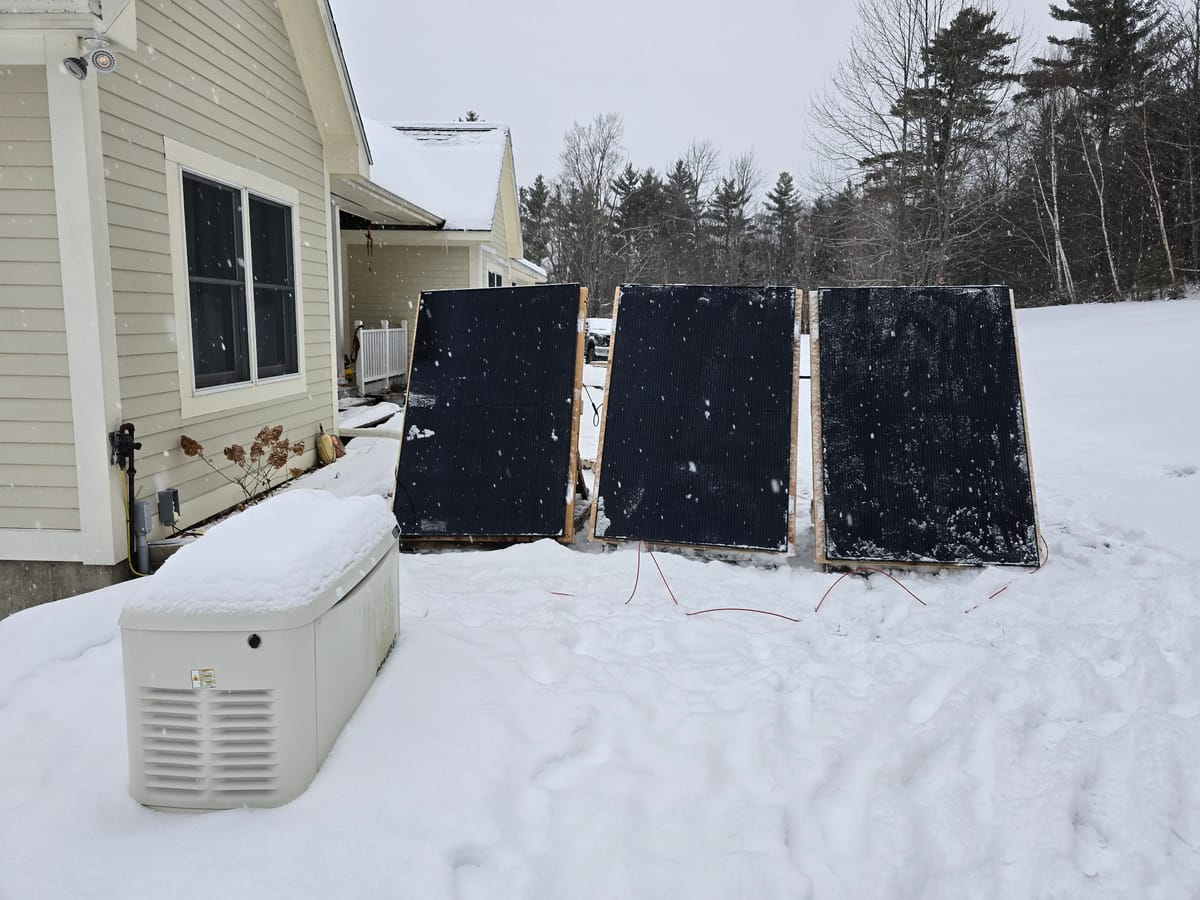
Within the next couple of years, I plan to put a 20-25kW solar array out behind the house, enough to offset all of my electric consumption. Electricity here is ~0.25c/kWh and with heat pumps/oven/well, the ROI will be short.
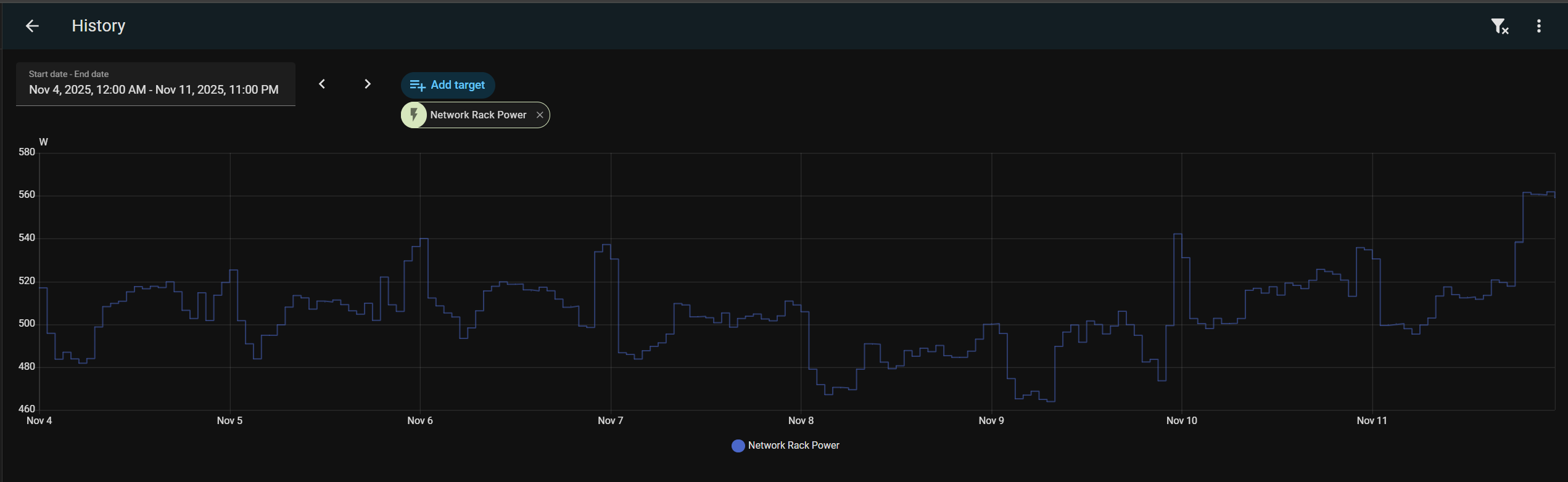
In the mean time, one of my largest consumers is my homelab. What started off a couple of years ago, when we lived down south (with cheap electricity), as an old recycled server has grown to half of a 48U rack. I have a Fortinet powered network stack, two hosts (one of which is an AMD EPYC whitebox build with 100TB+ of intel optane fronted storage and tons of PCIE accessories), and a multitude of IOT gear. I host a fairly typical suite of homelab services including plex, home assistant, frigate nvr, and this website. The rack is on a dedicated circuit and idles around 500W. At current exorbitant CMP rates, this gear costs me about $3/day to run.
Last year, a relative gave me a couple of ecoflow delta pros and 8 400W bifacial solar panels. The ecoflows, marketed as "solar generators", are pretty neat units - each one has 3.6kWH of lifePO4 storage on board, an inverter capable of 3600W continuous output, and an onboard solar MPPT that can accept 1600W of input. We've used them camping a number of times, but I wanted to put at least one of them to work 24x7. Eventually, I plan to use both of them and a subset of the panels to power a large 30x48 greenhouse we purchased just before winter.
My homelab was the perfect target load to partially offset. It's relatively constant, predictable and fed by a UPS+PDU at the bottom of the rack, so I could plug it directly into the Delta Pro. It is programmable such that you can set battery thresholds below which to charge on AC + solar, and above which to charge on solar only. Some of the newer ecoflows have true UPS capability (10ms switchover), but the older Delta Pro does not. When it switches between battery and AC passthrough, there's a ~30ms blip, enough to cause issues with server power supplies. To get around this, I plugged an aging Liebert UPS in in front of the Delta Pro - this handles immediate switchover, while the Delta Pro provides extended runtime, like a much larger UPS.
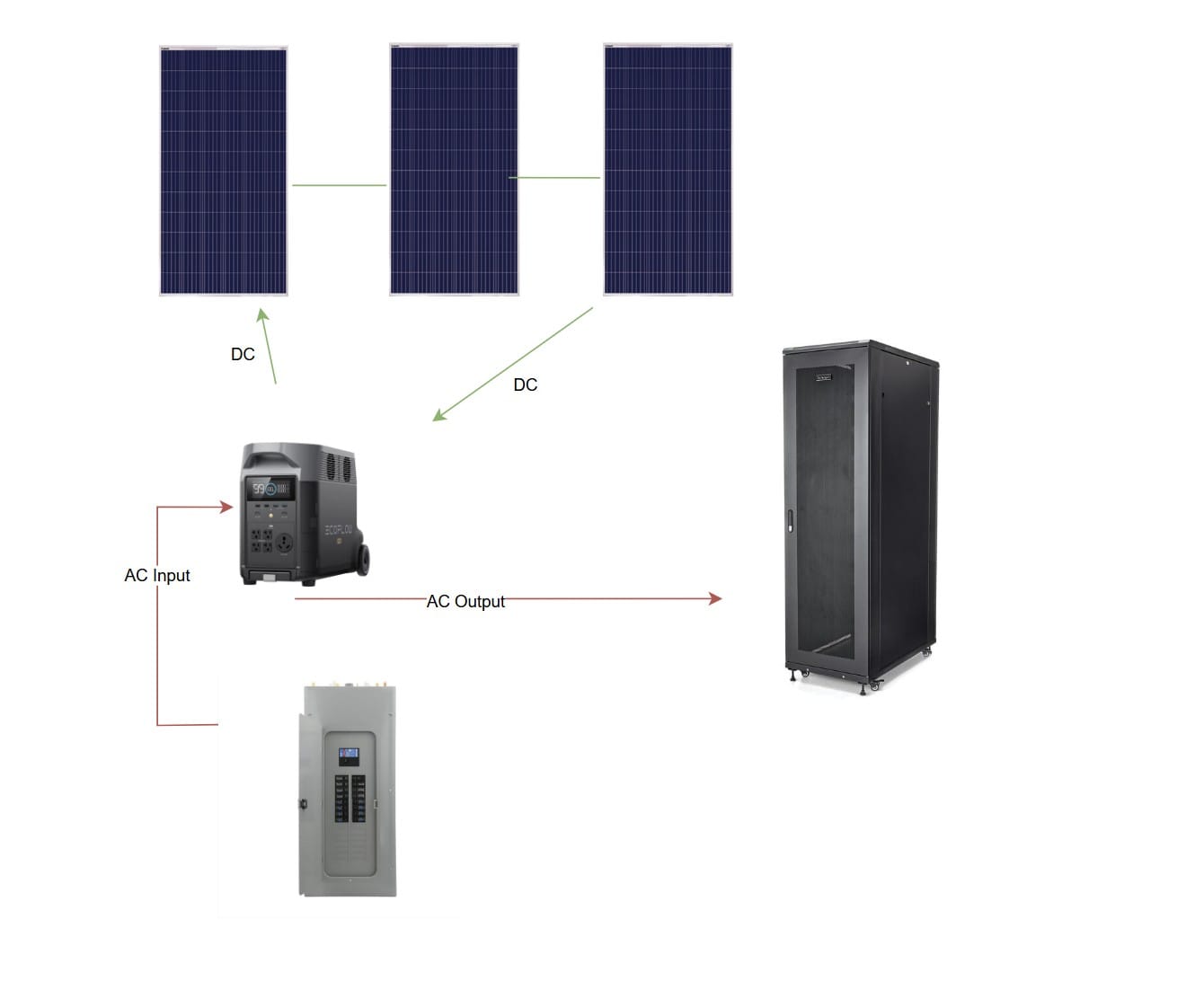
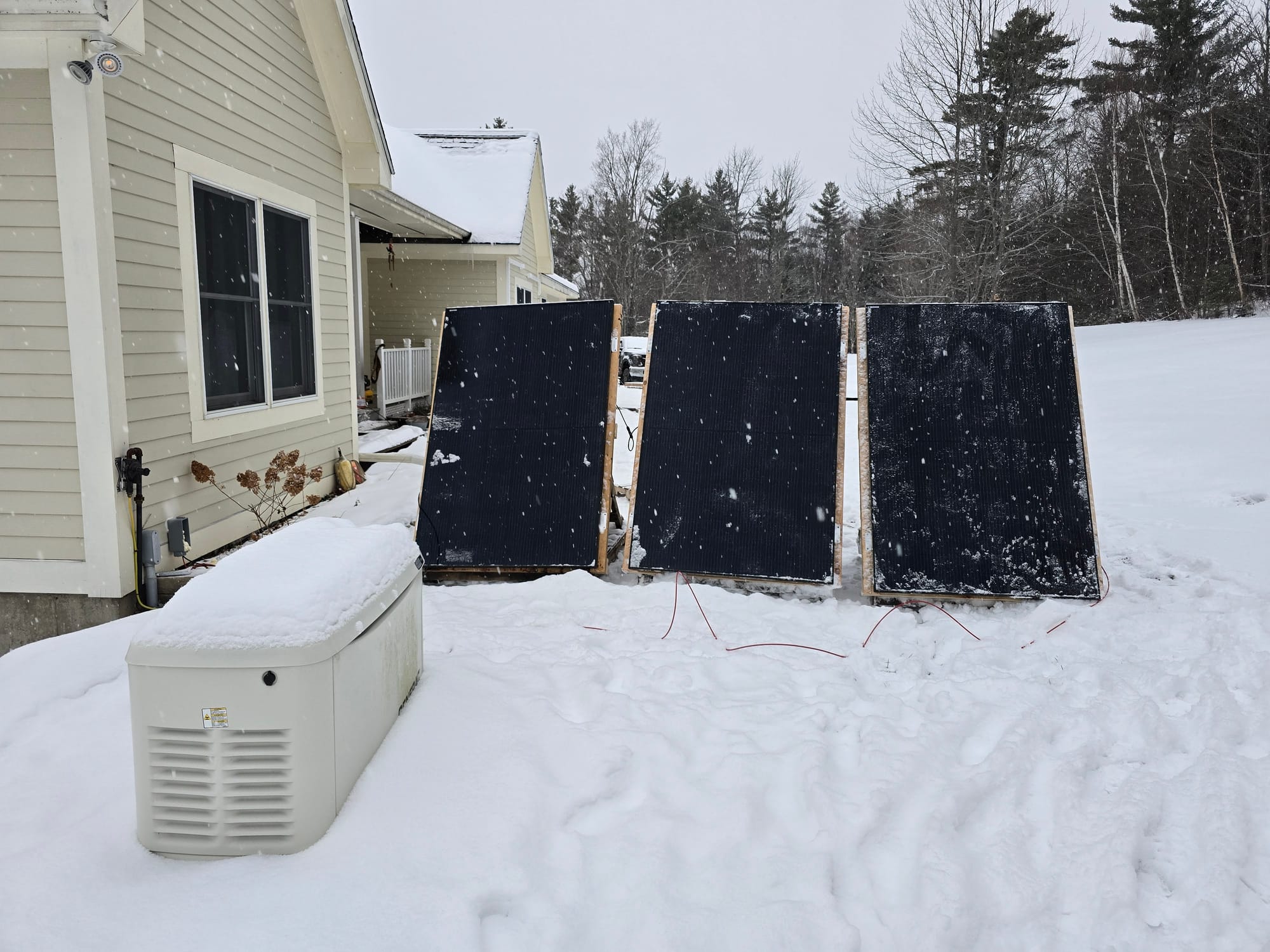
The solar panels were 400W Hyperion bifacial panels, rated at ~31V and ~13A a piece. The ecoflow has a maximum voltage cutoff of 150V and a maximum solar input current of 15A. The current is "drawn" by the unit and can be exceeded on the panel string, but voltage cannot. Above 150V will damage the internal MPPT. On paper, I could string 4 panels together in series to make 120V @ 13A. Panel voltages are rated at 25C, and panels gain significant voltage at the cold winter temperatures we experience here. I used the thermal coefficient to calculate Voc at -20F (about the coldest we ever see here) - it was nearly 40V per panel, putting me over the 150V threshold. I decided on a 3 panels in series setup for now, for 90-100V @ 13A maximum input (1300W max rated output).

Circling back to the greenhouse - with this being a temporary setup, I wanted to build something cheap and portable. I opted to recycle some pallets to build the solar ground mounts. I used 3 pallets and a pair of 2x4s per panel. I ripped off the first slats of all 3 panels and A framed them together, basically following this video. It was important the spacing of the boards supporting the slats was relatively consistent between pallets so that they'd line up. I used some scrap 2x4s as blocking between the boards at the top, offsetting one pallet to the left of the base pallet and the other to the right. Finally, I spiked it all together with a nail gun and added 6 foot 2x4 rails to the front to have a nice consistent surface to mount the panels. Ideal year-round panel angle is roughly your latitude, so I set everything to a 45ish degree angle. To mount the panels to the 2x4s, I used these cheap Z brackets, 4 per solar panel at the pre-drilled mounting holes.
I picked up 100ft of 10ga PV cable and some MC4 connectors/crimper. I punched a 2" conduit hole in the wall leading to my basement (should be big enough to support cabling to my permanent PV setup) and wired the panels in series. Back at the ecoflow in the basement, I have an XT60 to MC4 cable to attach the ecoflow to the standard MC4 connectors on the panel cables. I have yet to add an external fuse (the ecoflow has some level of protection near as I can tell), but I will soon.
With the basics in place, I plugged the ecoflow into my dedicated AC circuit, the rack UPS to the ecoflow, and the solar panel cables to the solar input. I configured it via the ecoflow app to charge to 50% on AC + solar, and above that use only solar. In practice, the unit's output has a deadband (so that it's not constantly swapping between AC passthrough and inverter when you're near 50%). At 50%, plugged into the wall, it will use AC passthrough to power loads and solar to charge the battery until it hits 60% charge, at which point it will stop AC passthrough, invert power from the battery to maintain the AC loads, and continue charging via solar. If solar input < AC output, it will eventually cycle down to 50% and repeat this process. At peak sun, solar input will exceed my 500W load and continue maintaining the battery + the AC load.
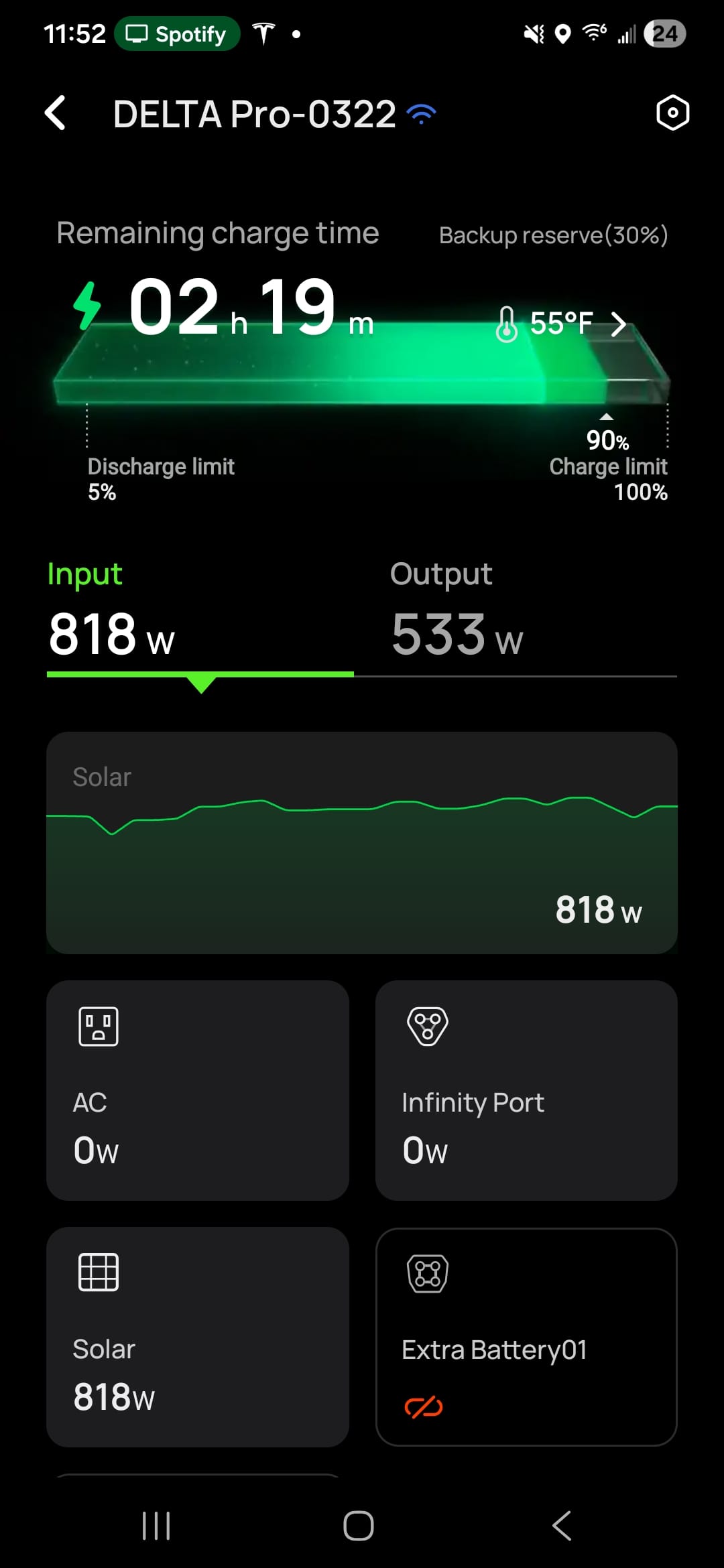
I got this setup around the shortest day of the year and have some trees blocking sun early in the morning (these will soon be destroyed by excavator to make room for larger PV array), so input is far from optimal. As the days lengthen and my time of production goes up (and the trees come down via excavator), I will likely lower the AC charge level on the unit to give me more headroom to charge via solar. I'm also considering adding the other ecoflow unit into the mix with an additional 3 panels - I think in summer months, I could run the lab 24x7 this way.
To keep track of things, I integrated the ecoflow with home assistant via this integration and added it to my electricity overview card (bubble card with sub buttons).
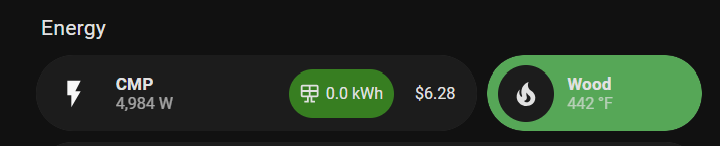
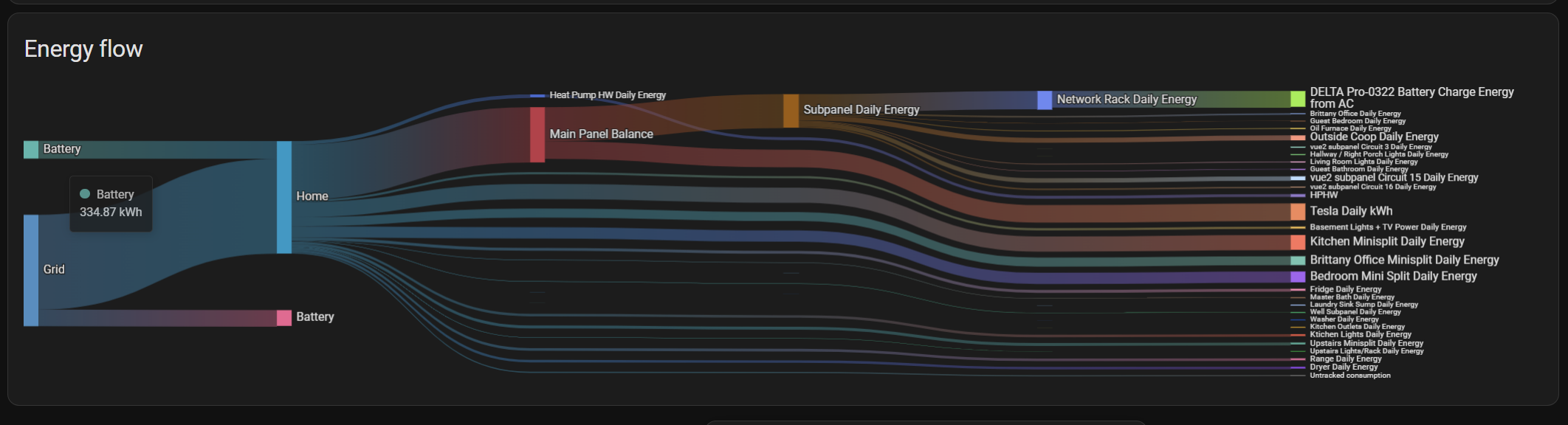
I leveraged some of the other sensors exposed by this integration to reconfigure home assistant's baked in energy dashboard. I setup the relationships of circuits to sensors (the ecoflow being a child entity of network rack circuit, which itself is a child circuit of my subpanel, all measured with a pair of Emporia Vues).
Sunny days have been a rare thing this winter, but we've had a few for me to gauge system performance. On the sunniest of these short and cold winter days, the battery charges to 60% by about 10:30am and runs the the rack in its entirety until 3-4PM, producing ~3.2kWH of energy. Being literally the shortest days of the year and with some trees in the way, I expect this to go up significantly as we get into spring/summer.
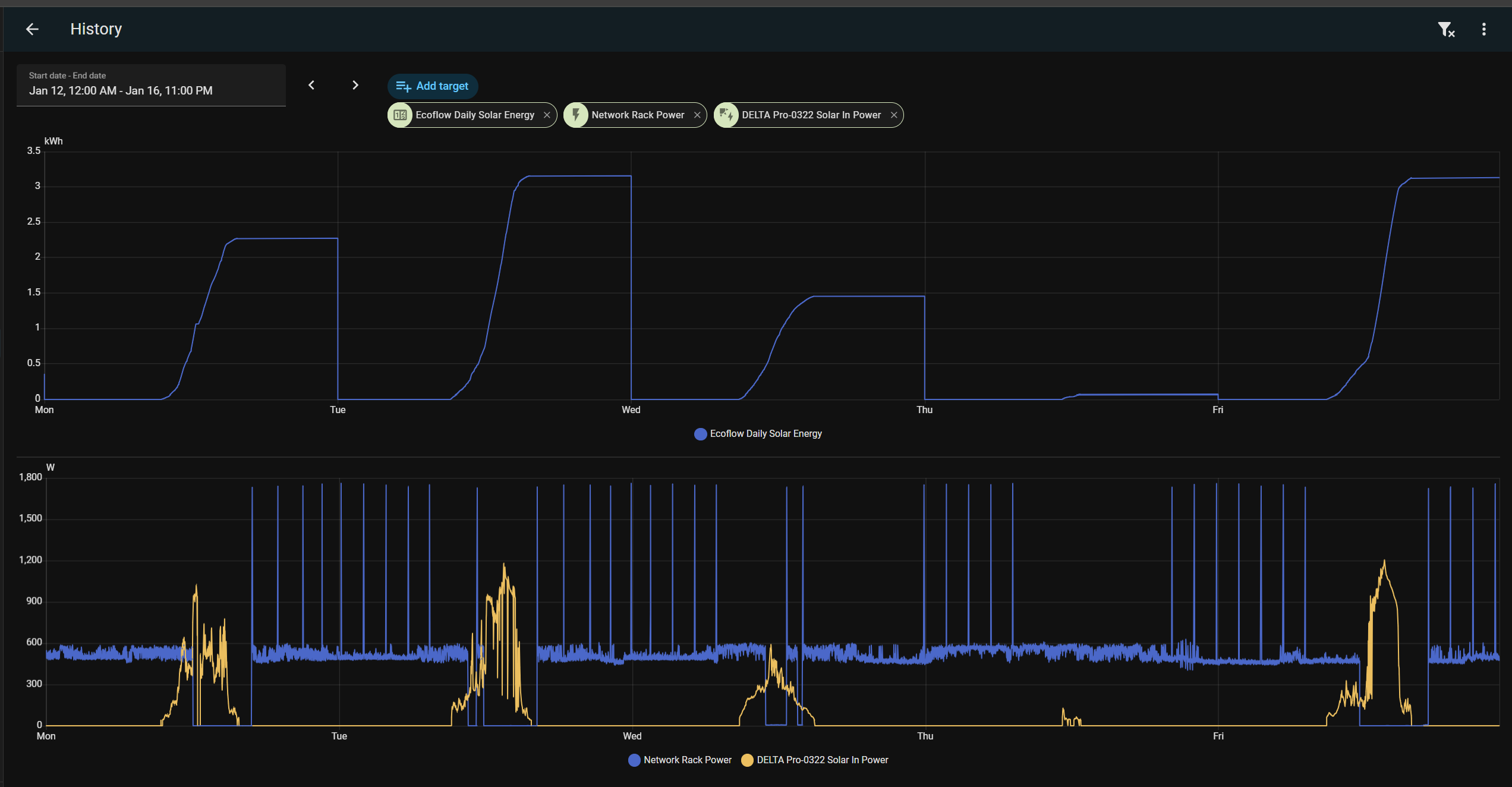
At today's rates, offsetting 3.2kWh / day saves about $0.80, or a little better than a quarter of the 12kWH of energy my rack is using per day.